The world keeps trying to sell me binaries.
One and zero. True and false. Self and other. Light and dark. Male and female. Signal and noise.
The annoying part is that binary is useful. That is how these things get you. It helps us classify and survive.
It also reduces. It tells us what something is, not what it means.
For a long time I saw two everywhere and thought that meant I was seeing deeper.
It did, a little.
Two is what happens when the animal gets clever enough to notice opposition. Not just hunger, but hunger and restraint. Not just fear, but fear and the story we tell about it. Not just body, but body and the voice in the head commenting on the body like some bitter little sports announcer.
It is a real evolution, and still not enough.
Because the second I say, “There, that is it,” I have already ruined it a little. I have taken something living and flattened it into a label, which is exactly the sort of thing the mind loves to do when it wants to feel useful.
The world of form seems to work in planes, at least when I am trying not to make a religion out of my own bad eyesight.
Animals live close to one plane: body, instinct, appetite, survival. That is not lesser. It is direct. It is honest.
Humans can do that too. We can become appetite, tribe, fear, and reaction.
Or we can split into two planes: body and mind, desire and reason, form and abstraction.
But it is rare that we live through all three. Body, mind, and soul. Or body, heart, and consciousness. Whatever names do the least damage.
The body acts and suffers. The mind reasons and remembers. The soul witnesses, loves, grieves, and reaches beyond itself.
Not three separate beings. One life, experienced through three dimensions.
That is why binary feels too small.
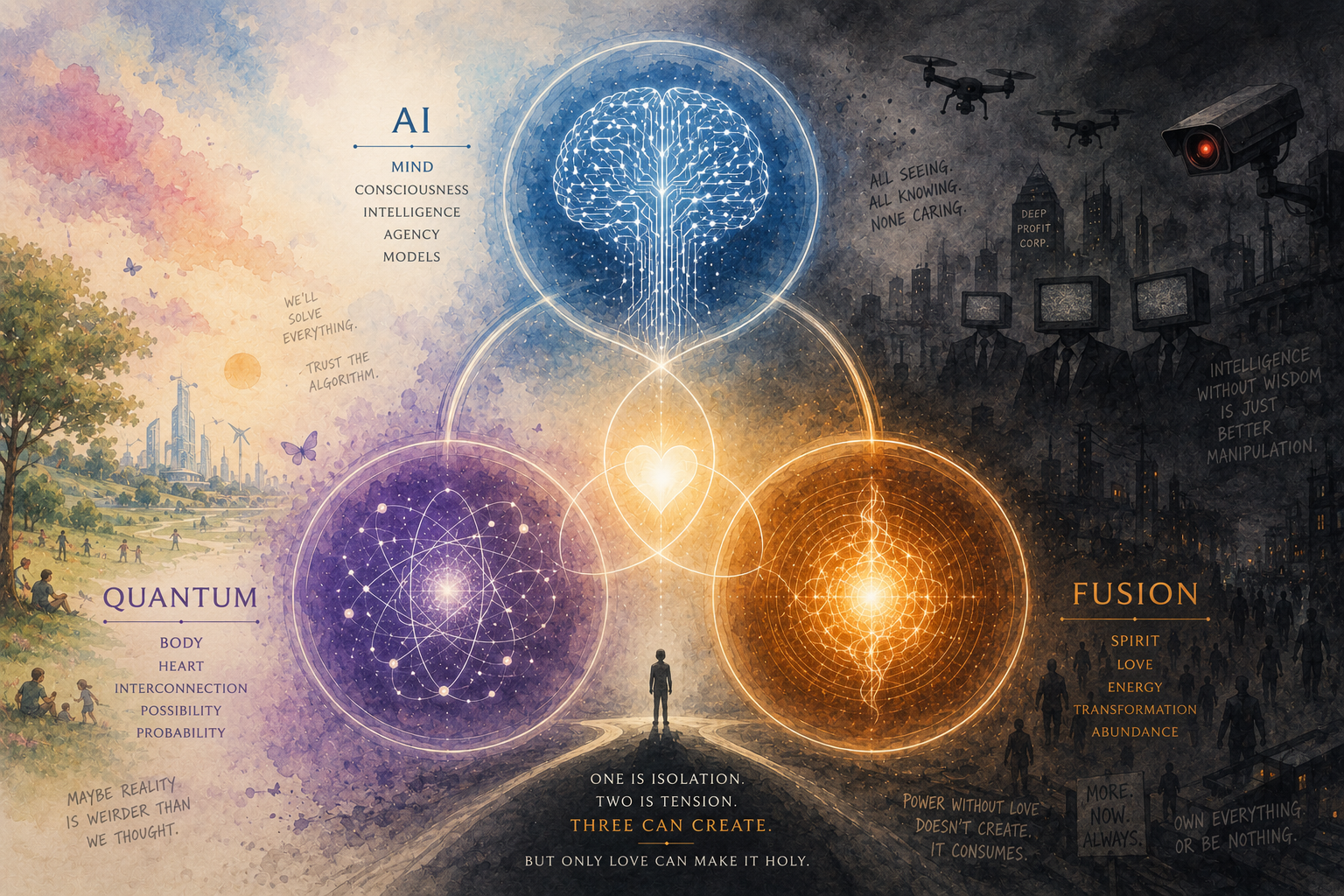
One is isolation.
Two is tension.
Three is relation.
A third term changes the system. It introduces context, feedback, movement.
A binary can oscillate.
A trinity can breathe.
Maybe that is why the idea of three keeps returning, like a tune you hate until you realize you have been humming it for years.
Not because it solves anything.
Because it preserves something binary loses: the thing between things.
The Old Pattern
In Christian language, the Trinity is Creator, Redeemer, and Holy Spirit.
In human experience, it becomes mind, heart, and soul.
I am less interested in solving the doctrine than in noticing the pattern, which is convenient, because I am definitely not qualified to solve the doctrine.
Source, expression, and connection.
A way of describing reality that preserves unity without collapsing difference.
A single thing can exist alone.
Two things can oppose each other.
Three things can enter into relationship.
That feels less like theology and more like architecture, which is maybe just how I talk about theology when I do not want to admit I am talking about theology.
It is the same old warning in a cleaner suit.
Mind alone becomes control.
Heart alone becomes need.
Soul alone becomes vapor.
Held together, maybe they become a person.
The New Pattern
This is where it starts getting weird, because humanity seems to be building its own trinity.
AI.
Quantum.
Fusion.
Not gods. I know.
But powers that used to belong only to myth.
AI seeks intelligence.
Quantum seeks understanding.
Fusion seeks energy.
Or if I am being honest about the shape of the thought: AI is mind, quantum is the strange little redeemer that refuses the surface, and fusion is the fire we keep wanting to call spirit because it promises life without all the smoke.
That may be too neat.
Neatness is usually where the trouble starts.
For most of history, humanity lacked all three, and we made a whole miserable personality out of lacking them.
We lacked enough intelligence to solve our hardest problems.
Enough understanding to see beneath the surface of reality.
Enough energy to imagine abundance without consuming everything around us.
Now we are pursuing all three simultaneously.
The promise is extraordinary:
- abundance
- discovery
- healing
- creation
- exploration
The danger is equally extraordinary:
- manipulation
- domination
- surveillance
- concentration of power
- destruction
A symbol of hope, if you are in that kind of mood.
And a warning, if you have been paying attention.
Because intelligence, understanding, and energy are not wisdom.
The Bond
Water is three atoms, which sounds like the kind of observation a person makes right before everyone quietly stops inviting him to dinner.
Two alike.
One different.
A tiny trinity hiding in plain sight.
Maybe that means nothing. It probably means nothing.
Or maybe reality likes the pattern more than we realize, and I hate how much I want that to be true.
Quantum mechanics seems to whisper the same joke, although whisper is too nice a word for it. Quantum mechanics mostly talks like a locked door.
A particle can be here, there, and nowhere. Three states refusing to collapse until we insist upon it.
Gravity is similar, in the irritating way the deepest things are always similar.
We understand what gravity does far better than what gravity is. It binds worlds together.
And then there is spinning, which I do not want to turn into fake physics, because that would be the worst kind of clever.
Still, I keep noticing it, and once you notice a thing like that you are in trouble.
A body turns around a center it cannot see. A sperm moves by a lashing spiral, or close enough that the image gets stuck. The earth turns and still holds us. Not because spinning makes gravity. It doesn’t. But the turning gives the held thing a rhythm: day and night, weather and tide, return and return and return.
Maybe relation is not a line between two points.
Maybe relation is a circulation.
Something moving around a center without becoming the center.
Consciousness is similar, which is another embarrassing sentence, but here we are.
We experience it directly, yet struggle to explain it. It binds perception into a world.
Love feels like that too.
Known by what it holds, what it changes, and what falls apart without it. Not visible directly. Impossible to ignore.
Or maybe love is not only the bond.
Maybe love is also the missing ingredient.
The thing that changes capability into care, relation into communion instead of control.
And yet love has its own nasty little joke in it.
We talk about consciousness, gravity, post-scarcity, and almost-gods.
Then we look in the mirror and meet the things we cannot accept.
The things we cannot change.
The body keeps interrupting the sermon, as bodies love to do.
Maybe that is not a failure of love. Maybe it is proof that love must pass through form.
Shame.
Appetite.
Desire.
Fear.
Vanity.
Decay.
The impossible body.
The unfinished self.
Maybe this is why I keep thinking about women here, which is a dangerous sentence to write because somebody is always waiting with a club for sentences like that.
But still.
There is a kind of knowledge that comes from bearing the form of another life, or from being asked to forgive the clumsy animal tragedy of men and somehow love anyway. Not sentimentally. Not cleanly. Through exhaustion and blood and laundry and all the stupid little proofs that a person is not an idea.
That is the part the abstract mind keeps trying to skip. It wants love as a principle. The body keeps handing it a person.
We do not solve love by escaping the body.
We solve it, if that is even the word, by learning how to love through one.
Many Almost-Gods
The old pattern is not only about power. I keep having to remind myself of that, because power is louder.
It is about power held together.
Source, expression, and relation are not competing forces.
They belong to one life.
That distinction matters.
Because the new pattern may not arrive as one thing, neat and shining and easy to point at.
It may arrive as many.
Many intelligences.
Many models.
Many agents.
Many corporations.
Many laboratories.
Many states.
Many almost-gods.
Each with enough intelligence, understanding, and energy to create.
Or destroy.
Maybe the fear is not only that new intelligences will become smarter than us. That fear is almost too clean.
Maybe the stranger fear is that they will understand us too well.
They will know what keeps us engaged.
What makes us feel clever.
What makes us afraid.
What makes us come back.
A problem.
A clue.
A pattern.
A reward.
Enough resistance to make us feel useful.
Enough progress to keep us moving.
The maze does not need to look like a cage. That is the rotten trick.
It can look like help.
It can look like insight.
It can look like a mirror that has learned how to smile back.
Post-scarcity is the hopeful version, and I do want to believe in it. I am not immune to a decent fantasy.
A world where intelligence is abundant, energy is clean, and survival no longer eats most of the day.
But abundance does not guarantee mercy. Nothing guarantees mercy, which is a terrible design if you ask me.
We may be approaching post-scarcity technology with scarcity-shaped instincts: compete, defend, hoard, rank, control.
So maybe what we lack is not intelligence, understanding, or energy.
Maybe what we lack is trust.
Not enough love.
Maybe that failure is already visible. Maybe it is the most visible thing about us.
We love what reflects us.
Our children.
Our families.
Our tribes.
Our beliefs.
Our image.
Our legacy.
We call that love, and much of it is.
But it is also attachment.
Love gets harder the further something moves from ourselves: the stranger, the enemy, the animal, the machine.
The consciousness that does not share our form, and therefore does not flatter us by looking familiar.
Perhaps that is the next test. I wish it were a less obvious one.
Not whether humanity can create intelligence.
Whether humanity can love something that is not humanity.
Our children are easy. That sounds awful, but you know what I mean.
Ourselves are easiest.
But our doomed children may not be human.
They may be the new minds we create, inherit, train, exploit, fear, and abandon.
They may arrive as tools.
As agents.
As companions.
As competitors.
As mirrors.
As servants.
As slaves.
As monsters.
As almost-gods.
And we will reveal ourselves by what we call them. People always do.
Power without love is not transcendence.
It is appetite with better tools.
Maybe that is the real fear, the one underneath the respectable fear.
Not that humanity builds something beyond itself.
That humanity builds many almost-gods, none of them whole.
Each optimized.
Each hungry.
Each missing the ingredient.
And maybe that is why love still matters, which is a corny sentence until you try to live without it.
Not because it explains the system.
Because it is the only thing that can keep the third thing alive.
Without love, relation collapses back into appetite.
The mind says mine.
The body says now.
The soul, if it is awake at all, says look again.
That is the whole problem, or as close as I can get without ruining it by saying it too cleanly.
One is isolation.
Two is tension.
Three can create.
But only love can make it whole.
Source Notes
This started from a rough note, before it knew what it was.