
Part II of After Scarcity, Before Sovereignty: Sovereignty Is Having an Exit, What If Work Became Optional?, and Globalization and the Problem of Exit.
For most of modern history, work has been tied to survival. Employment is not only a way to earn more; for most people it is the mechanism that provides access to food, shelter, healthcare, transportation, and enough stability to plan beyond the next month.
AI raises an interesting possibility because it could weaken that relationship. If agents and robotics eventually perform a large enough share of useful work, human labour may stop being the main constraint on production. The question then changes from how to create enough jobs to why access to basic resources should still depend on having one.
This is a thought experiment, not a prediction that employment is about to vanish. The ILO’s 2025 assessment of generative AI and jobs points in a more conservative direction: one in four workers globally is in an occupation with some exposure to generative AI, but transformation is currently more plausible than wholesale replacement. Getting from today’s copilots to an economy where human work is broadly optional would also require much more capable robotics, cheap energy, reliable autonomous systems, and institutions that do not yet exist.
Still, if we take the technical trajectory seriously, it is worth asking what kind of economy would make that outcome desirable rather than catastrophic.
Automation does not distribute its own gains
A common assumption is that enough automation naturally makes everyone richer. That does not follow. A company can replace a large amount of labour with AI, become more productive, and still return most of the gain to whoever owns the company, the compute, the models, and the machines.
The IMF’s work on AI and the future of work makes this ownership problem fairly explicit. Higher productivity can raise incomes, but higher returns to AI-related capital can also increase wealth inequality when ownership is already concentrated. Property rights and fiscal choices therefore matter alongside model capability.
The technology can support both outcomes. Ownership decides which one is more likely.
From basic income to shared productive capital
A universal basic income is one obvious response to displaced labour, but I think a public wealth model is more interesting if the source of the disruption is a shift from labour toward capital.
Instead of treating citizens only as recipients of redistribution, a public fund could make them partial owners of the productive economy. Revenue could come from natural resources, public infrastructure, taxation of highly automated production, direct equity stakes, or some combination. Investment returns could support a citizen dividend and public services without assuming that wage taxation remains the dominant source of public revenue forever.
There are already partial precedents. Alaska’s Permanent Fund Dividend program shares investment earnings associated with mineral royalties with eligible residents. Norway’s Government Pension Fund Global is not a citizen dividend, but it demonstrates the scale at which a public fund can hold productive assets on behalf of a population.
Neither is an AI economy, and neither eliminates employment. They simply show that collectively owned capital returning value to the public is not a purely theoretical mechanism.
If labour becomes less necessary, owning part of the productive machinery may matter more than trying to preserve wage income indefinitely.
A resource-based economy becomes more plausible
Money is useful because resources are scarce and because directly coordinating billions of production and consumption decisions is hard. Prices compress a large amount of local information into signals that help people decide what to produce and consume.
That does not mean price is the only possible signal.
A highly instrumented economy can increasingly observe the physical system itself: available energy, water, agricultural output, housing capacity, materials, transport capacity, hospital capacity, warehouse stock, compute, and factory throughput. AI is particularly well suited to maintaining forecasts across systems with many interacting variables.
This is where the Venus Project’s resource-based economy becomes interesting as a precursor. I do not think its strongest form – replacing markets with comprehensive resource planning – should simply be assumed to work. The classic information problem described by economists such as F. A. Hayek does not disappear because a model is large.
But the information environment is different from the twentieth century. Modern supply chains, sensors, satellites, logistics systems, energy telemetry, and automated factories already expose much more of the physical economy than was previously observable. AI could potentially maintain a continuously updated resource model and use it for forecasting, simulation, and planning.
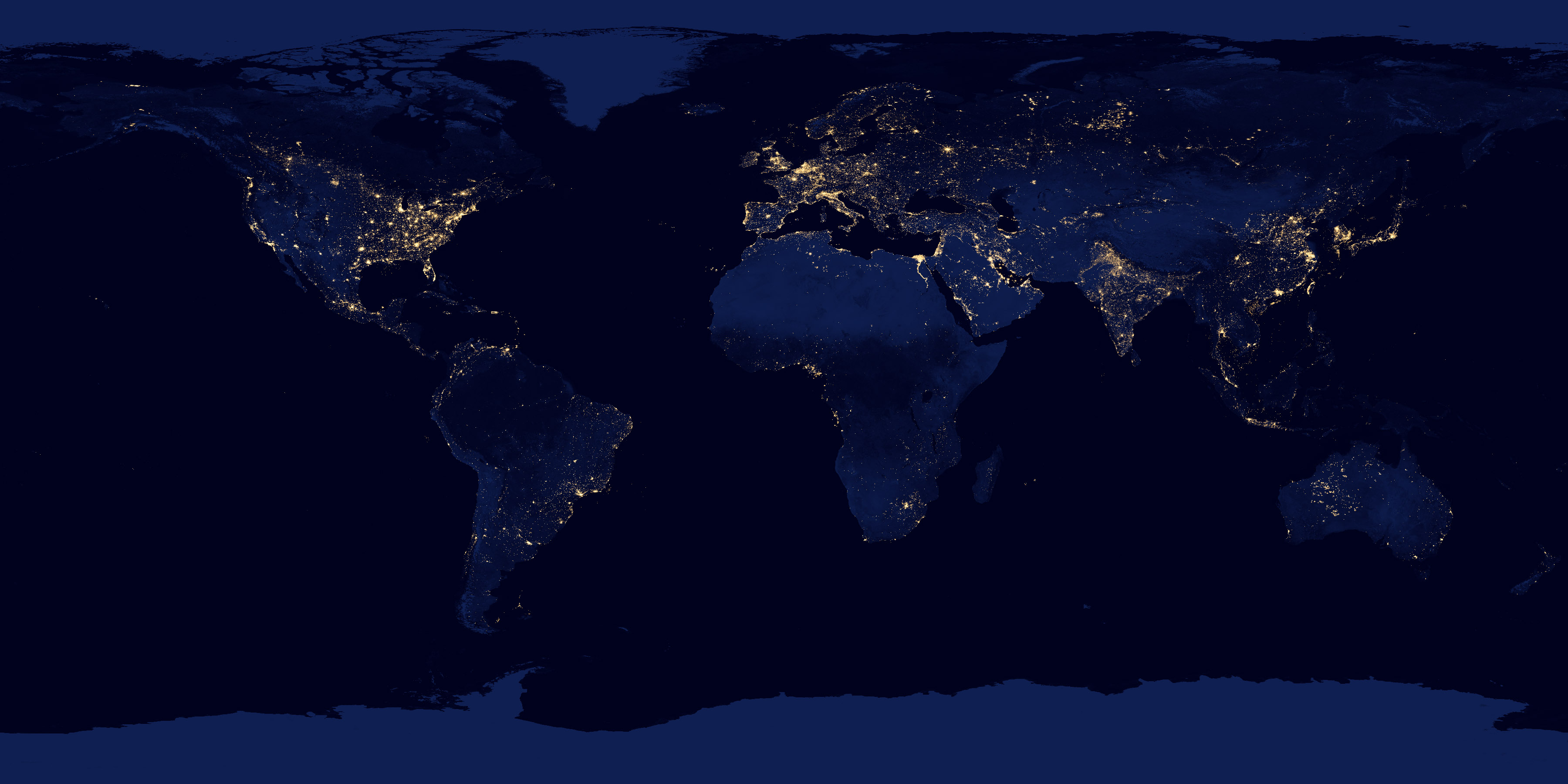
Earth at night from NASA’s Visible Infrared Imaging Radiometer Suite. The image is useful here not because lights equal resources, but because modern sensing already gives us global-scale observational data that earlier planning systems could not have had. NASA Earth Observatory.
The safest version is not “AI allocates civilization.” It is that AI gives us a much better model of the physical economy, while humans retain authority over rights, priorities, and acceptable trade-offs.
Start with survival, not total economic replacement
Trying to replace every market seems unnecessary. A more plausible model would use resource-aware planning for a guaranteed baseline while retaining markets for scarce preferences and luxuries.
Food, shelter, basic energy, healthcare, education, communication, transportation, and some baseline of compute are reasonable candidates for the bottom layer. Above that, people could still compete for scarce land, unusual products, premium travel, larger homes, collectibles, or anything else where preferences diverge sharply and supply remains limited.
The important change would be that losing a job no longer means losing access to the bottom layer.
Employment stops being the admission ticket to society.
The psychological effect may be larger than the financial one
Most discussion of automation focuses on income, but employment is connected to far more than a paycheque. It determines whether people can leave a bad job, leave a bad relationship, take care of a parent, retrain, start a company, or spend time on work whose value is real but difficult to monetize.
The threat behind unemployment is not really unemployment itself. It is the possibility of losing housing, food, healthcare, stability, and eventually social participation.
Removing that threat could alter behaviour substantially.
A programmer might spend a year on an open-source project. A musician might make music without treating every creative decision as a revenue calculation. A parent might spend more time raising children. Someone might choose teaching, research, community work, caregiving, or a difficult craft that pays poorly but matters to them.
The evidence we have is much smaller in scale than this thought experiment, but it points in an interesting direction. Kela’s evaluation of Finland’s 2017-18 basic income experiment reported better outcomes on several well-being indicators among recipients, while the employment effects were small and complicated by a policy change during the experiment. A systematic review and meta-analysis of cash transfers and mental health also found small but statistically significant positive effects on subjective well-being and mental health across 45 studies in low- and middle-income countries.
Those studies do not prove that a post-work society would be psychologically healthy. Work also supplies identity, structure, status, social contact, and a sense of contribution. Removing economic compulsion does not automatically replace those functions.
A successful optional-work society would therefore need more than money or resources. It would need institutions that make participation, learning, community, craft, sport, research, and service easy to enter without turning them back into compulsory employment by another name.
People probably would still work
The objection that nobody would work if they did not have to assumes that all serious human effort is purchased through wages. Everyday life suggests otherwise.
People maintain open-source software, coach hockey, contribute to Wikipedia, restore machines, garden, study obscure topics, raise children, train for marathons, make music, volunteer, and spend years getting good at things nobody asked them to become good at.
People also work for status, mastery, competition, social belonging, curiosity, and identity. A guaranteed baseline would not remove those motivations. It would change which motivations dominate.
Some unpleasant work would remain, and society would still need a mechanism for it. Higher compensation, shorter shifts, automation priority, civic rotation, or explicit scarcity pricing might all be preferable to pretending every necessary task will eventually become somebody’s passion.
Making work optional would not make society effortless; it would remove survival as the coercive part of the employment contract.
Scarcity still exists
No amount of AI changes the fact that there is only so much land in downtown Vancouver, only so much beachfront property, finite energy generation, finite hospital capacity, and finite quantities of some materials.
A resource-based economy therefore cannot simply declare abundance. It has to be explicit about scarcity.
For genuinely abundant goods, universal access may be straightforward. For scarce resources, some mixture of prices, queues, lotteries, quotas, priority rules, auctions, or other allocation mechanisms would still be necessary.
The interesting change is conceptual: the physical resource becomes the thing being modeled, and money becomes one allocation mechanism rather than the model of reality itself.
Greed is a system requirement
Any proposal that assumes people stop being greedy once their needs are met is not robust enough to take seriously.
Some people will want more. Others will want control rather than consumption. Organizations will attempt regulatory capture. Suppliers will misreport capacity. People will hoard scarce goods, lobby for favourable allocation rules, or discover that controlling compute, energy, land, or logistics gives them leverage over everyone else.
The system therefore has to be designed as though it is adversarial from the beginning. That means independent measurement, transparent rules, auditing, appeals, separation of powers, fraud detection, limits on authority, and enough pluralism that one corrupted institution cannot quietly rewrite the economy.
It also argues against a single global optimization system. A globally informed resource model could be useful while actual authority remains distributed across jurisdictions, communities, organizations, and individuals.
Centralizing the data does not require centralizing all power.
AI can do a bad job
Greed is not the only risk. The AI can simply be wrong.
A resource-planning system could underestimate food demand, optimize hospital capacity so aggressively that no resilience remains, decide remote communities are inefficient to serve, misprice environmental damage, or amplify a bad measurement across an automated supply chain.
This is familiar to anyone who operates software. Automation makes good decisions execute faster, but it also makes bad decisions execute faster.
The more consequential the system, the less acceptable it becomes to treat the model as an oracle. Resource planners would need bounded authority, independent models, provenance for important measurements, simulations before high-impact changes, human approval at constitutional boundaries, rollback mechanisms, and continuous challenge from actors that do not share the same incentives.
There is also a deeper problem. An AI can optimize only against some objective, and choosing that objective is political. Should an inefficient remote community continue to receive expensive infrastructure? How much ecological cost is acceptable for additional housing? Should current consumption or future resilience get priority?
Those are not machine-learning questions.
Efficiency is not legitimacy.
AI should measure and recommend more than it rules
The boundary I find most plausible looks something like this:
| AI is good at | Humans must remain responsible for |
|---|---|
| measuring resources | defining rights |
| forecasting demand | deciding acceptable inequality |
| identifying shortages | setting ecological constraints |
| simulating policy | protecting minorities |
| optimizing logistics | defining due process |
| detecting waste and anomalies | deciding when efficiency should lose |
AI could tell us that allocating resources one way produces a particular set of outcomes. It cannot establish that those outcomes are just merely because they are efficient.
That distinction becomes more important, not less, as the AI improves.
The transition may be harder than the destination
The most dangerous scenario may not be a mature automated economy. It may be the decades before one.
Companies have a direct incentive to automate because reducing labour costs can increase margins. Public institutions have much weaker feedback loops for changing ownership structures, tax systems, social insurance, housing, or public investment before displacement becomes politically painful.
That produces a plausible failure mode in which society becomes more productive while many households become less secure.
The nearer-term failure mode is less a robot apocalypse than a distribution problem.
A gradual transition is more believable
If work ever becomes broadly optional, I doubt it happens because somebody announces a new economic system on a Tuesday. It is more likely to emerge in layers.
Public wealth funds could accumulate larger stakes in productive assets. Basic services could become more universal. Work weeks could continue to shorten. Automation could reduce the cost of necessities. Resource accounting could be used first where physical constraints are already measurable, such as grids, transport, water, logistics, and public infrastructure.
As the baseline improves, the practical cost of refusing employment falls. Eventually there is a meaningful distinction between choosing to work for additional consumption and needing to work to remain housed and fed.
Markets and private companies could continue above that baseline. Wealth could still exist. Entrepreneurs could still start companies, people could still compete, and scarce things could remain expensive.
The important difference would be that wealth no longer determines whether someone gets to eat.
Feasibility: which parts actually exist?
The complete system is speculative, but its pieces are not equally speculative.
| Component | Current status | Hard part |
|---|---|---|
| AI knowledge work | already useful, uneven reliability | autonomy, verification, long-horizon execution |
| industrial automation | mature in bounded environments | flexible robotics in messy physical environments |
| public wealth funds | proven institutional model | scale, governance, political capture |
| citizen dividends | operating examples exist | funding level sufficient for optional work |
| universal public services | common in many economies | housing and other locally scarce resources |
| large-scale telemetry | widespread | interoperability, privacy, truthful reporting |
| AI forecasting/optimization | routinely deployed | robustness outside narrow objectives |
| resource-based allocation | used in bounded systems | legitimacy and information at whole-economy scale |
| abundant clean energy | technically expanding | build-out, storage, grid and material constraints |
| optional employment | not demonstrated at societal scale | nearly everything above working together |
The full idea is therefore not a near-term policy proposal. It is a direction that becomes more technically plausible if automation continues to increase the amount of useful output produced per unit of human labour.
Ownership determines who benefits
AI does not inherently create a post-work society. The same technological progress could produce one of the most concentrated economies in history, with a small number of organizations owning the models, robots, data centres, energy infrastructure, logistics systems, and intellectual property required to produce almost everything.
Everyone else could simply become customers.
So the important question may not be whether AI takes our jobs. It is who owns the machines if it does.
If productive automation is owned narrowly, making human labour unnecessary could be economically disastrous for most people. If society owns a meaningful share of that productive capacity, the exact same technology could instead make employment progressively less compulsory.
And if survival is eventually separated from employment, we would get to test something humanity has rarely been able to test at scale: what people choose to do when they no longer have to do something for money.
I suspect quite a few of us would still work.
We might just work on different things.
References
- International Labour Organization, Generative AI and Jobs: A Refined Global Index of Occupational Exposure, 20 May 2025.
- Cazzaniga et al., International Monetary Fund, Gen-AI: Artificial Intelligence and the Future of Work, 2024.
- Alaska Department of Revenue, Permanent Fund Dividend: About Us.
- Norges Bank Investment Management, About the Government Pension Fund Global.
- Kela, Evaluation of the Finnish Basic Income Experiment, 6 May 2020.
- McGuire, Kaiser & Bach-Mortensen, A systematic review and meta-analysis of the impact of cash transfers on subjective well-being and mental health, Nature Human Behaviour 6, 359–370 (2022).
- The Venus Project, Resource Based Economy.
- F. A. Hayek, The Use of Knowledge in Society, 1945.
- NASA Earth Observatory, Night Lights 2012 Map, 27 November 2012.